

Silver Spring, Maryland, USA, July 12, 2026— The Indonesian Muslim Association in America (IMAAM) Center hosted a book review and discussion of Islamic Personal Finance at its headquarters in Silver Spring, Maryland. Held in a hybrid format, the event attracted approximately 50 participants from the United States, Canada, Malaysia, Indonesia, Syria, and several African countries.
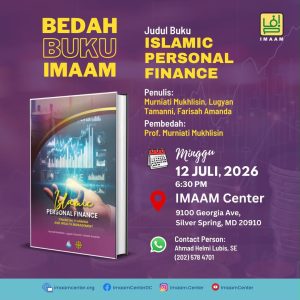
The event was part of Murniati Mukhlisin’s speaking tour in Canada and the United States, sponsored by Dompet Dhuafa USA. Better known internationally as Madam Ani, Murniati joined the discussion alongside her co-authors. The session was moderated by Ahmad Helmi Lubis, Coordinator of the Book Review Program at IMAAM Center.
Islamic Personal Finance is co-authored by Murniati Mukhlisin, Luqyan Tamanni, and Farisah Amanda. Published in English in December 2025, the book is jointly released by the International Institute of Islamic Thought East and Southeast Asia (IIIT ESEA) and the International Islamic University Malaysia (IIUM).
Opening the discussion, co-author Farisah Amanda reflected on the inspiration behind the book and its seven-year journey to publication.
“I was deeply inspired after reading “Sakinah Finance” written by Madam Ani and Mr. Luqyan in 2013. I told Madam Ani that although the book was excellent and accessible to the general public, there was also a need for a comprehensive academic textbook. That conversation marked the beginning of this project. We started writing in early 2019 under the guidance of the Research and Community Empowerment (LPPM) of Tazkia University, and completed the first draft in 2022,” said Farisah, a graduate of Tazkia University’s Master of Islamic Economics program who now resides in Manchester, United Kingdom.
Murniati Mukhlisin and Luqyan Tamanni are the founders of Sakinah Finance, an Islamic personal and family financial literacy institution that has delivered educational programs in 23 countries over the past 18 years. Both were also among the pioneering team members involved in the development of Tazkia University from its early years as a higher education institution. Today, Murniati serves as Professor of Islamic Accounting at Tazkia University, while Luqyan Tamanni is the Head of BSI Institute.

During her presentation, Murniati explained that the book underwent an extensive academic development process spanning nearly seven years.
“The manuscript went through two rounds of peer review between 2022 and 2024, followed by a comprehensive editorial process in 2025 before the first edition was finally published at the end of that year,” she said.
She explained that the book is organized into three major sections: Personal Finance Fundamentals, Islamic Personal Finance Fundamentals, and Islamic Financial Planning.
The first section introduces the foundations of personal finance by discussing consumerism, financial literacy and education, including financial inclusion for persons with disabilities, the history and theories of personal financial planning, and behavioral finance.
The second section presents the Islamic worldview on personal finance through the writings of classical Muslim scholars such as Ibn Sīnā, Al-Ghazālī, and Kınalızâde Ali Çelebi. It further explores Islamic perspectives on sustenance (rizq), spending, investment, debt management, and the importance of understanding Islamic contracts (ʿuqūd) in financial transactions.
The final section provides a comprehensive guide to Islamic financial planning. Readers are equipped with practical exercises on preparing personal and family cash flow statements and net worth statements, while also learning shariah principles related to wealth creation, wealth accumulation, achieving financial goals, wealth protection through takaful, wealth purification through zakat, voluntary charity and waqf, as well as wealth distribution through hibah (gifts), waṣiyyah (Islamic wills), and farāʾiḍ (Islamic inheritance).
“As a bonus chapter, we also provide a detailed guide to retirement planning, complementing earlier discussions on preparing education funds, Hajj and Umrah savings, and taxation issues,” Madam Ani added.
Murniati expressed her hope that Islamic Personal Finance would serve as a primary textbook for undergraduate and graduate courses in Islamic economics, finance, and financial planning. At the same time, she acknowledged that the first edition still leaves room for further development.
According to her, one limitation of the current edition is the lack of case studies addressing the financial realities faced by Muslim diaspora communities, particularly those living in North America. While the book includes cases from various countries, it does not yet comprehensively discuss financial planning within the legal and financial systems of the United States and Canada.
She also noted that the chapter on wealth distribution could be expanded in future editions.
“Although the book presents several interesting and relatively complex inheritance cases, the discussion on Islamic inheritance across different legal jurisdictions has not yet been explored in sufficient depth. This is certainly something we plan to improve in the next edition,” she said.
The two-hour discussion concluded with an engaging question-and-answer session covering a wide range of topics, including home financing through mortgage systems in the United States and Canada, debt settlement among family members, and the motivation behind writing the book.
One of the participants, Sigit Afrianto, an AIRBUS aircraft engineer based in Montreal, Canada, who joined virtually, raised a question about the concept of “Life with Minor Debt” discussed in Chapter 9.3 of the book. “I have read the book, and I would like to learn more about Madam Ani’s perspective on Life with Minor Debt, debt that remains within one’s financial capacity and merely reduces assets rather than creating financial distress with the objective of maximizing asset utilization to benefit others and support Islamic outreach,” he asked.
Responding to the question, Madam Ani emphasized that Islam does not prohibit debt as long as it is acquired lawfully, remains manageable, and can realistically be repaid. “A small and well-managed productive debt can serve as a tool, rather than becoming a burden. While this is not an absolute rule, I often recommend a practical 10–20–30–40 financial allocation framework: allocate at least 10 percent for zakat, sadaqah, and waqf; at least 20 percent for investment and financial protection; no more than 30 percent for the combination of productive and consumer debt; and no more than 40 percent for daily living expenses. The objective is not to maximize borrowing, but to maximize maslahah, the broader social benefit. When productive assets are managed wisely, they can generate greater value, enabling Muslims to support their families, help those in need, and contribute more effectively to Islamic da’wah without compromising their financial stability.”
As the session drew to a close, Madam Ani addressed another question regarding spending priorities from the perspective of al-kasb (earning and wealth acquisition in Islam). She explained that Islamic financial ethics encourage Muslims to prioritize spending first on their own essential needs, followed by debt repayment, financial support for one’s spouse and children, care for parents, and subsequently extending assistance to relatives and the wider community.
The event concluded with lively discussions and meaningful exchanges among participants from diverse professional and cultural backgrounds, reaffirming the growing global interest in Islamic personal finance as a practical framework for achieving both financial well-being and spiritual fulfillment.
Source: Sakinah Finance Public Relations